Do you dream of owning your business? Do you spend hours sketching out amazing ideas, watching videos of successful entrepreneurs, and telling friends, "One day, I'm going to launch this huge company?" If so, you might be what the business world calls a wantrepreneur.
A wantrepreneur is someone who is perpetually thinking and planning, but never actually takes the leap. This position is comfortable, exciting, and, unfortunately, stagnant. During my days of employment, I was surrounded by people who had incredible business ideas, but most never took that crucial step into becoming an entrepreneur. Why? The most common reason is fear. Fear of the unknown, fear of losing that stable income, and fear of failure. It took me time to finally overcome that crippling fear, and I want to show you how you can do it too.
1. What is the Biggest Difference Between an Entrepreneur and a Wantrepreneur?
The distinction between these two roles is the very foundation of business success. It’s not about intelligence, creativity, or even having a "perfect" idea.
The Key Difference: Decisive Action
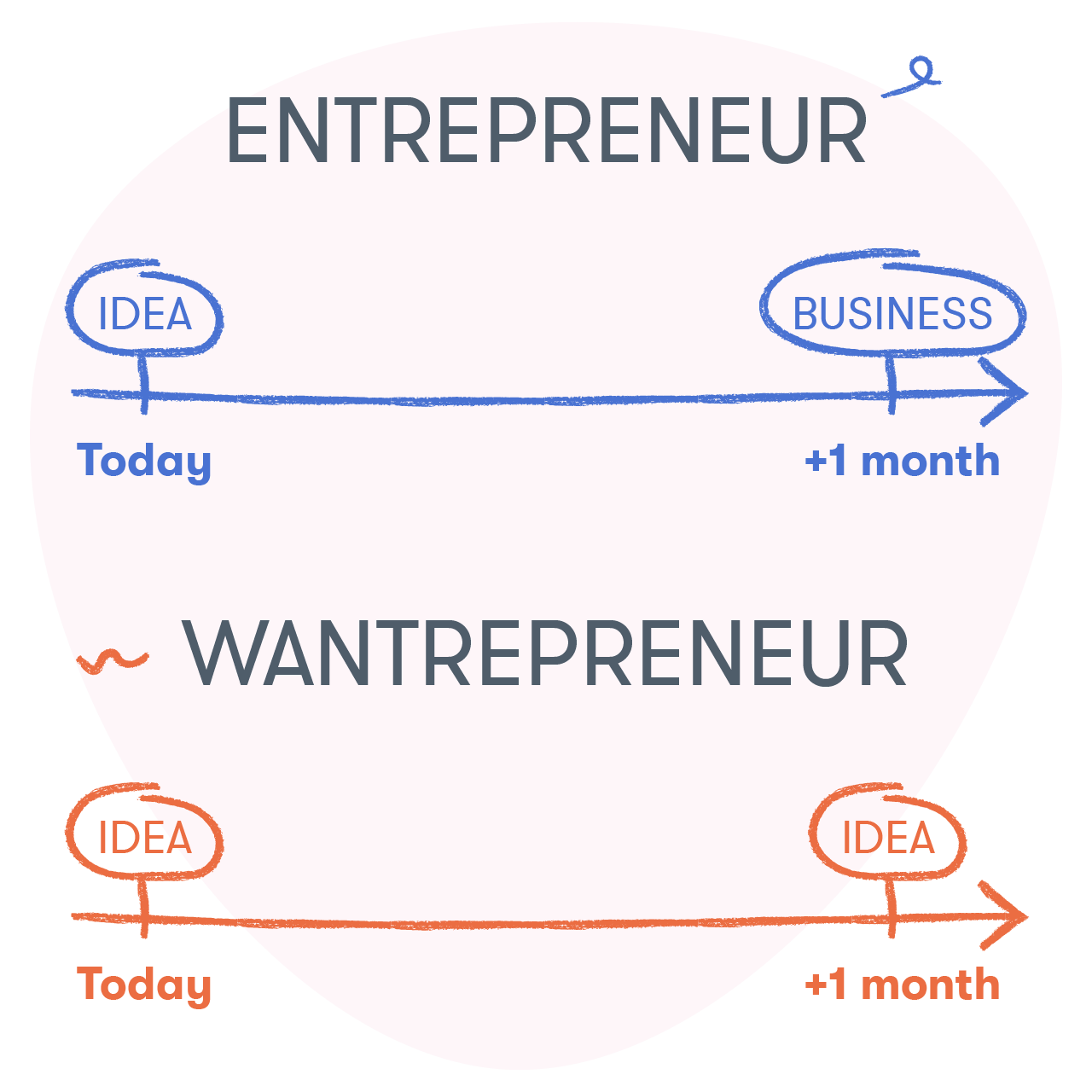
The biggest difference between an entrepreneur and a wantrepreneur boils down to consistent, decisive action.
The Wantrepreneur:
This individual lives in the land of "what if." They prioritize talking, planning, and waiting for the "perfect" moment, the "perfect" idea, or the "perfect" funding. They focus on minimizing risk and consuming information, not creating products.
The Entrepreneur:
This individual lives in the land of "doing." They move from planning to action quickly. They understand that waiting for perfection is paralyzing. They prioritize building a minimum viable product (MVP), testing it with real customers, getting feedback, and iterating. They see failure not as a personal defeat, but as essential market research.
The primary strategy for transitioning from a wantrepreneur to a successful entrepreneur is simple, though challenging: stop talking and start executing.
2. Overcoming the Obstacle: The Fear of Failing
The most common reason people get stuck in the "wantrepreneur" cycle is fear. This fear is a normal human instinct, we worry about survival, stability, and disappointing our loved ones. For many, this fear crystallizes into the exaggerated image that if they don’t succeed in their venture, they might end up facing financial ruin.
Facing the Falsehood of Fear
It is important to challenge these scary thoughts with reality. In most cases, even if a business venture fails, you will find a way to survive and provide for your family.
The world rarely ends with one failed startup. The truth is, that stable job you are clinging to isn't as secure as you think, it can disappear tomorrow. You are simply trading the fear of a business risk for the risk of a corporate layoff.
Fear is normal, but it shouldn’t prevent you from achieving your dreams. You must develop an entrepreneurial mindset focused on resilience and continuous learning.
3. How to Stop Being a Wantrepreneur: The 7 Proven Strategies
The journey from dreaming to doing requires a strategic shift in mindset and practical preparation. Here are the seven pointers that helped me make the transition to a full time entrepreneur.
Strategy 1: The Honesty Audit
Before you quit your job, you must be ruthlessly honest with yourself.
Is this a true passion?
Is being an entrepreneur something you truly want to do, or is it one of those "I want what they have" feelings when you read about successful entrepreneurs?
Are you willing to pay the price?
Ask yourself: are you willing to work harder than you've ever done before and consistently put yourself in uncomfortable situations?
For me, this meant selling. Going out and selling was not something I did easily, yet I had to push myself to do it because it was essential to the success of our business. So, be honest with yourself about your commitment to growth.
Strategy 2: Change Your Company (Your Environment)
Your environment shapes your thinking. For the longest time, my only circle of acquaintances consisted of employees. They were smart and ambitious people, but to get my mindset to think like a business owner, I needed to change my environment.
Surround yourself with the right and like-minded people: Seek out folks who are smart and ambitious, especially those who are already successful business owners.
Find Mentors: Mentors are essential. They can advise you and calm your fears because they are real people who are out there doing what you want to do. If you don’t know any mentors, check out your local startup community or Small Business Administrator office in your city.
Attend Networking Events: This is where you meet people whose normal is what you are striving for. This will quickly change your perspective and reduce the fear of the unknown.
Strategy 3: The Knowledge Overcome Strategy
One of the main reasons fear exists is because of self-doubt. Thoughts like, "I don’t know how to start a company," "I haven’t run a business before," or "I’m not an expert," are all voices of the wantrepreneur.
Knowledge is power: You can defeat these doubts by educating yourself. Try to learn as much as you can by reading books, attending webinars, and taking classes.
Acquire Necessary Skills: Before I started my current business, I wished I had taken more time to acquire the necessary skills and taking responsibility for my financial future. You can learn accounting, basic coding, or digital marketing before taking the leap.
Strategy 4: Have a Plan (But Don't Paralysis)
Benjamin Franklin once said, "If you fail to plan, you are planning to fail." A plan is essential, but it must be a roadmap to action, not a document meant to gather dust.
Financial Runway: Your plan should include how much money you need to save before starting your venture. You should have at least one year of personal expenses saved up. This is your survival budget, and having it dramatically reduces the fear of losing your stable income.
Funding and Logistics: Ask yourself: How much funding do you need for your new business? Meet with a lawyer and accountant to make sure all your legal and finances are in order before you take that leap.
Prototype Strategy: Can you build a prototype or a minimum viable product (MVP) and test it out? Can you build it yourself or do you need to outsource it? The planning here must lead immediately to building and testing.
Strategy 5: Gain Real Experience (The Side Hustle)
Nothing beats experience. There is so much you can read and learn from books and webinars, but it’s not until you go out and do it that you learn the most.
Start Small on the Side: Just go out and do something on the side, no matter how small it is. This is your training ground where some of that fear will start to fade.
Test Your Idea: Create a prototype if you want to build a product. Take a side job if you want to start a service company. Go out and meet customers, talk about your idea, get feedback. This process of getting real-world experience is the antidote to the wantrepreneur's overthinking.
Strategy 6: Provide Value to Customers
The core of the entrepreneurial mindset is not about chasing money; it's about providing value to customers.
Solve a Problem: Successful businesses solve real problems for real people. Shift your focus from "How can I make money?" to "What pain point can my product or service eliminate for someone else?"
Focus on the Customer: Use the feedback from your early tests and prototypes (Strategy 5) to continuously improve how you provide value to customers. When you know your product solves a problem, the confidence to sell it overcomes the fear of failing.
Strategy 7: Define Your Success on Your Own Terms
One of the biggest fears is failure defined by others (e.g., losing prestige). You need to define success on your own terms.
Success is Learning: For a beginner, the first year of business is successful if you learn how to market, how to sell, and what the customer truly needs—even if the business doesn't make a profit.
Resilience is Key: Understand that the entrepreneurial journey is not a straight line. Embrace resilience and view setbacks as necessary lessons that refine your approach. Starting a business is hard, but fear shouldn’t be an excuse for not trying.
4. Transitioning to be an Entrepreneur – Your Revolutionary Path
What if transitioning to be an entrepreneur was as simple as doing what you love and having a clear system to support you? What if you can become an integral part of a global family that supports and cares about you, fostering personal and professional development?
Many people attempt the transition alone and fail due to isolation, lack of mentorship, and a vague understanding of how to master the art of wealth creation. That's why having a revolutionary approach is so critical.
The Wealth Creators Method: Beyond Traditional Teachings
Our innovative approach defies traditional teachings and empowers individuals to transcend their limitations. The Wealth Creators Method is a meticulously crafted, comprehensive system that guides you in mastering the art of wealth creation.
By joining a community and adopting a proven system, you move beyond mere dreaming and into a structure that guarantees action, accountability, and practical learning. This revolutionary approach tackles the very fears and lack of knowledge that keep the wantrepreneur stuck, providing the missing pieces:
A Clear Roadmap: Replacing vague dreams with actionable steps.
Mentorship and Company: Providing the critical network you need (Strategy 2).
Accelerated Knowledge: Giving you the necessary skills to defeat self-doubt (Strategy 3).
The difference between dreaming and doing is action. You now have the proven transition strategies needed to move from a hesitant wantrepreneur to a decisive successful entrepreneur. The key is to address your fears, prepare financially, seek mentorship, and, above all, start doing something today.
Are you trying to make the transition to being an entrepreneur? How are you overcoming your fears?
It's time to stop planning and start building. Learn the revolutionary approach to wealth creation that turns action into phenomenal success.
General Disclaimer: Your Growth Compass is an educational and informational platform, not a registered financial advisory service. All cryptocurrency and investment information provided is for educational purposes only. Bitcoin and other digital assets are highly volatile and inherently risky. We are not liable for any financial losses, profits, or investment decisions you make. Always conduct your own due diligence or consult a certified financial professional before investing
Latest Articles



© 2025 Your Growth Compass SA All Rights Reserved